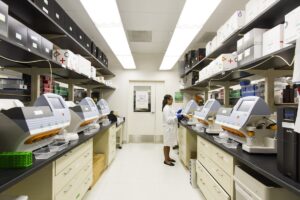
The integrity of peptide research compounds relies heavily on the environmental and operational controls established within the processing facility. As the demand for high-purity analytical references grows, maintaining a rigorous sterile handling laboratory environment is no longer optional; it is a fundamental requirement for supply chain reliability and analytical accuracy. This article explores the critical workflows, environmental controls, and quality assurance protocols necessary to safeguard complex peptide matrices during laboratory manipulation.
Establishing the Sterile Handling Laboratory Environment
Designing a sterile handling laboratory requires a comprehensive approach to facility engineering, focusing on airflow dynamics, pressure cascades, and filtration efficiency. For facilities processing high-value research compounds such as Semaglutide and Tirzepatide, the primary processing zone must typically meet ISO 5 classifications. This is achieved through the use of unidirectional laminar airflow hoods equipped with HEPA or ULPA filtration. The HVAC system must maintain positive pressure differentials between the core processing areas and adjacent ante-rooms or corridors, ensuring that ambient air does not infiltrate the critical zone. Temperature and relative humidity controls are also strictly regulated to prevent condensation and minimize the proliferation of environmental microbes, which is essential for preserving the structural integrity of sensitive raw materials.
Aseptic Technique and Personnel Protocols
The most significant source of contamination in any sterile handling laboratory is the human operator. Therefore, stringent personnel training and gowning protocols are paramount. Operators must undergo rigorous qualification in aseptic technique before being permitted to handle open peptide vials or analytical standards. Gowning procedures typically involve a sequential donning of sterile garments, including hair covers, face masks, specialized cleanroom suits, and sterile gloves. Gloves must be sanitized frequently with validated sporicidal agents. Within the critical zone, movements must be slow, deliberate, and kept to a minimum to avoid disrupting the unidirectional airflow. All manipulations should occur within the first six inches of the airflow source to ensure maximum particulate and microbial clearance.
The integrity of any analytical reference or research compound is inextricably linked to the environmental controls maintained during its manipulation. A sterile handling laboratory is not merely a physical space, but a dynamic, validated system designed to mitigate contamination risks at every operational phase.
Material Transfer and Equipment Sterilization
Introducing raw materials and equipment into the sterile handling laboratory presents a critical control point. Materials such as GHK-Cu or Glutathione must be transferred through validated pass-through boxes equipped with interlocking doors and internal UV sterilization or HEPA-flushed airlocks. Prior to entry, the exterior surfaces of all primary packaging must be meticulously wiped down with appropriate disinfectants. Furthermore, the disinfectants used within the facility must be rotated on a scheduled basis to prevent the development of microbial resistance. The contact time for these agents must be strictly validated to ensure efficacy against the specific bioburden profile of the laboratory. For facilities engaged in large-scale OEM/ODM formulation development, the transfer of bulk processing equipment requires additional engineering controls, such as specialized material airlocks with continuous air showers. All processing equipment, including vials, stoppers, and mixing vessels, must undergo terminal sterilization via autoclaving or dry heat depyrogenation to ensure the complete elimination of bioburden and endotoxins.
Environmental Monitoring and Analytical Verification
Continuous environmental monitoring is the cornerstone of quality assurance within a sterile handling laboratory. A robust monitoring program includes both viable and non-viable particulate sampling. Viable monitoring utilizes settle plates, active air samplers, and contact plates to detect microbial ingress, while non-viable particle counters monitor airborne particulate matter in real-time. Data from these monitoring activities must be systematically trended to establish alert and action limits. When trends indicate a shift toward the alert limit, proactive corrective and preventive actions must be initiated before an action limit excursion occurs. This proactive data management is essential for maintaining the Quality of the laboratory environment.
If any deviation is detected, or if a batch of research compound requires post-handling verification, orthogonal analytical techniques are deployed. Methods such as HPLC and Mass Spectrometry are utilized to confirm the identity, purity, and structural integrity of the peptide, ensuring it aligns with the original COA. This rigorous approach to environmental and analytical monitoring guarantees that the raw material remains uncompromised from the point of receipt through all subsequent laboratory manipulations.
| Environmental Parameter | ISO 5 (Grade A) Limit | ISO 7 (Grade C) Limit | Monitoring Frequency |
|---|---|---|---|
| Viable Air (CFU/m3) | < 1 | < 10 | Continuous / Per Batch |
| Settle Plates (CFU/4h) | < 1 | < 5 | Per Processing Session |
| Contact Plates (CFU/plate) | < 1 | < 5 | End of Session / Personnel |
| Particulate >= 0.5µm (particles/m3) | 3,520 | 352,000 | Continuous / Real-time |
Conclusion
Maintaining a sterile handling laboratory is a complex, multi-disciplinary effort that requires continuous vigilance, advanced engineering, and strict adherence to standardized protocols. By implementing these rigorous workflows, research organizations and formulation laboratories can ensure the reliability and reproducibility of their analytical data. PeptaCo supplies materials for qualified research, analytical, and formulation-development purposes. Products are not intended for direct consumer use.