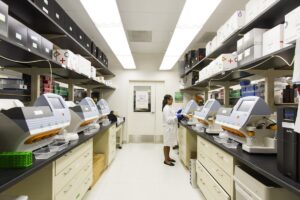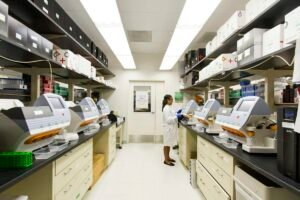
Sterile Handling Laboratory Dynamics in Peptide Research
The structural and chemical integrity of peptide raw materials is fundamentally tied to the environmental controls established during secondary processing and analytical evaluation. As the receptor research landscape expands, the demand for pristine analytical references has elevated the sterile handling laboratory from an optional luxury to a critical supply chain requirement. Maintaining rigorous aseptic conditions is paramount to preventing bioburden proliferation and particulate contamination, which can severely compromise downstream analytical data and formulation stability.
In a B2B supply chain context, the transition of materials from primary packaging to analytical workflows introduces significant contamination vectors. A meticulously controlled sterile handling laboratory environment mitigates these risks, ensuring that the physicochemical properties of complex peptides remain unaltered prior to rigorous testing or integration into broader research matrices.
Controlling Bioburden and Particulate Vectors
The foundation of any sterile handling laboratory is the strict adherence to ISO 14644-1 cleanroom classifications. For peptide research and analytical reference preparation, ISO Class 5 (Class 100) environments are typically mandated. These environments utilize unidirectional laminar airflow systems equipped with HEPA or ULPA filtration to continuously sweep airborne particulates away from the critical work zone.
Environmental Monitoring and Viable Limits
Beyond non-viable particulate counting, a robust sterile handling laboratory must implement continuous viable monitoring. Settling plates and active air sampling are utilized to detect microbial contamination. The limits for these parameters are strictly defined to prevent the introduction of proteases or other biological contaminants that could degrade sensitive peptide sequences.
| ISO Classification | Max Particles (≥0.5 µm) / m³ | Settle Plates (CFU / 4 hrs) | Application in Peptide QA |
|---|---|---|---|
| ISO Class 5 | 3,520 | < 1 | Open peptide handling, reconstitution, and aliquoting |
| ISO Class 7 | 352,000 | < 5 | Secondary packaging transfers and equipment staging |
| ISO Class 8 | 3,520,000 | < 10 | General laboratory support and outer gowning areas |
Maintaining these limits requires rigorous personnel gowning protocols and standardized operational procedures. Even minor deviations in airflow dynamics or personnel movement can introduce particulate vectors that compromise the Quality of the material being evaluated.
Material Transfer and Aseptic Technique in Peptide Workflows
The physical transfer of peptide vials into the sterile handling laboratory represents a critical control point. Materials must be decontaminated prior to entry, typically utilizing sporicidal disinfectants applied via validated wiping protocols. For hygroscopic research compounds, this transfer must be executed rapidly to minimize ambient moisture exposure, which can alter the solid-state kinetics of the raw material.
When handling complex GLP-1 receptor research compounds such as Semaglutide, the risk of surface adsorption and particulate generation is heightened due to the molecule’s amphiphilic nature. Similarly, transition metal complexes like GHK-Cu require specialized handling to prevent unintended chelation or oxidation at the air-liquid interface during reconstitution.
For organizations engaged in OEM/ODM formulation development, the aseptic techniques employed during these initial handling stages dictate the baseline purity of the entire batch. Utilizing specialized antechambers and rapid transfer ports ensures that the external environment does not compromise the internal sterile field, preserving the integrity of the analytical reference.
Analytical Verification Post-Handling
Following the execution of sterile handling protocols, analytical verification is required to confirm that no degradation or contamination has occurred. This is achieved through orthogonal analytical frameworks. High-Performance Liquid Chromatography (HPLC) is deployed to assess purity and detect any new impurity peaks that may indicate hydrolytic or oxidative degradation introduced during handling.
Complementing chromatographic data, Mass Spectrometry provides exact mass verification, ensuring that the primary sequence of the peptide remains intact. By reconciling these post-handling analytical results with the original Certificate of Analysis (COA), laboratories can validate the efficacy of their sterile handling laboratory protocols. Any variance beyond established analytical thresholds necessitates a root-cause investigation into the aseptic workflows.
Strategic Implementation and Continuous Improvement
Establishing a world-class sterile handling laboratory is not a static achievement but a continuous process of validation and improvement. Routine requalification of airflow patterns, filter integrity testing, and personnel media fills are essential components of a comprehensive Quality management system.
The efficacy of a sterile handling laboratory is measured not just by its initial validation, but by its ability to maintain stringent environmental controls during routine, high-throughput analytical operations.
By prioritizing contamination vector mitigation, research organizations and compounding pharmacies can ensure that their peptide raw materials maintain the highest standards of analytical integrity, supporting reliable data generation and robust formulation development.
PeptaCo supplies materials for qualified research, analytical, and formulation-development purposes. Products are not intended for direct consumer use.