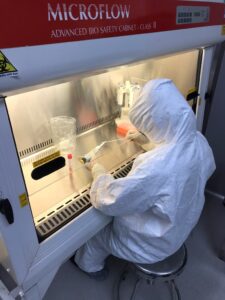
The Physics of Lyophilized Peptide Handling at Scale
Transitioning from analytical verification to batch-scale manufacturing requires a rigorous understanding of solid-state physics. When reviewing a COA for raw materials, buyers often focus on chromatographic purity and mass spectrometry data. However, the physical integrity of the lyophilized cake is equally critical. Proper lyophilized peptide handling is not merely a logistical step; it is a critical analytical control point that dictates the structural fidelity of the final formulation matrix.
As procurement teams source complex sequences for the receptor research landscape or cosmetic applications, the transition from milligram-scale analytical vials to gram-scale OEM/ODM processing introduces new physical variables. The porous structure of a lyophilized matrix is highly sensitive to environmental fluctuations. Understanding these dynamics is essential for maintaining the conformational stability of advanced research compounds.
Proper lyophilized peptide handling is not merely a logistical step; it is a critical analytical control point that dictates the structural fidelity of the final formulation matrix.
Mitigating Thermal Shock During Vial Transfer
One of the most significant risks during scale-up is thermal shock. Lyophilized materials are typically stored in cold-chain environments to preserve their solid-state stability. When these vials are transferred to ambient processing suites, rapid temperature differentials can induce micro-condensation within the primary packaging.
This localized moisture introduction is particularly detrimental to hygroscopic sequences. For instance, when handling complex multi-receptor analogs like Tirzepatide, even trace amounts of uncontrolled moisture can lower the glass transition temperature of the amorphous solid matrix. This can lead to cake collapse, increased residual moisture, and accelerated degradation pathways.
To mitigate thermal shock, Quality assurance protocols must mandate staged ambient equilibration. Vials should be transferred through a series of temperature-controlled antechambers, allowing the solid matrix to gradually acclimate to the processing environment. This prevents the dew point from being reached inside the vial, thereby safeguarding the physical morphology of the lyophilized cake prior to reconstitution.
Interfacial Shear and Reconstitution Dynamics
Once the material has safely equilibrated, the reconstitution phase introduces hydrodynamic variables. The addition of solvent matrices to a lyophilized cake generates interfacial shear forces. If the solvent is added too rapidly or with excessive kinetic energy, these shear forces can induce localized aggregation or conformational unfolding.
In cosmetic OEM formulations, preserving the structural integrity of the active sequence is paramount. For example, when integrating SNAP-8 into a topical matrix, or when preparing GHK-Cu for specialized applications, the reconstitution workflow must prioritize gentle solubilization. Laminar flow during solvent addition and controlled, low-shear agitation prevent the disruption of secondary structures.
Furthermore, the polarity and ionic strength of the reconstitution solvent must be precisely matched to the isoelectric point of the peptide. Mismatches in solvent thermodynamics can cause the peptide to precipitate or form insoluble interfacial films, severely impacting the homogeneity of the final bulk solution.
Analytical Verification Post-Handling
Following scale-up handling and reconstitution, orthogonal analytical verification is required to confirm that the physical handling protocols did not compromise the material. High-performance liquid chromatography and mass spectrometry are utilized to detect any handling-induced impurities, such as oxidation products or aggregation species.
The table below outlines standard handling parameters, their associated risk factors, and the corresponding QA mitigation strategies utilized in advanced formulation workflows.
| Handling Parameter | Risk Factor | QA Mitigation Strategy |
|---|---|---|
| Thermal Gradient | Micro-condensation and cake collapse | Staged ambient equilibration protocols |
| Solvent Addition Rate | Interfacial shear and localized aggregation | Controlled laminar flow addition |
| Agitation Method | Conformational unfolding | Gentle inversion and low-shear mixing |
| Headspace Gas Exchange | Oxidative degradation | Inert gas purging prior to sealing |
By strictly controlling these physical parameters, formulation scientists can ensure that the analytical profile of the reconstituted bulk solution perfectly mirrors the pristine raw material verified during initial sourcing. This rigorous approach to lyophilized peptide handling bridges the gap between theoretical purity and practical formulation success.
PeptaCo supplies materials for qualified research, analytical, and formulation-development purposes. Products are not intended for direct consumer use.