When the measured amount is lower than expected
An unexpectedly low peptide result does not immediately identify its cause. The discrepancy may arise from the starting content estimate, incomplete dissolution, dilution errors, changes in the sample, interaction with surfaces, or the analytical method itself. A useful investigation separates these possibilities before changing the formulation or rejecting the batch.
For laboratory teams, recovery is a question about a defined workflow: how much of the intended analyte can the method measure after the specified handling steps, relative to an appropriate reference? It is not a property that can be assigned to every peptide by reading a tube label. A recovery study must describe both the material and the process being assessed.
Confirm the starting basis first
Before comparing containers, confirm the expected input. A nominal powder mass is not always the same as the mass of peptide material, and HPLC area purity is not automatically a quantitative content result. Our purity-versus-content article explains the distinction. If the initial estimate is wrong, a perfectly consistent preparation can appear to have poor recovery.
Also check calculations, units, dilution records, and the identity of the material used. Confirm that the analytical method responds adequately over the intended range and that reference materials have an appropriate assigned value. A relative comparison can still be useful, but it should not be presented as an absolute mass balance unless the underlying measurements support that claim.
Do not infer loss mechanisms from appearance alone
A clear solution does not prove that all of the peptide is present in solution or that it remains chemically unchanged. Conversely, visible residue does not reveal whether it is peptide, an excipient, contamination, or another component. Discarding residue and reporting the remaining liquid as the full nominal concentration can introduce a substantial, unrecognized error.
Container adsorption is one hypothesis to investigate, not the default diagnosis for every low result. Precipitation, aggregation, degradation, and analytical interference require different evidence. When investigating a deviation, preserve relevant observations and compare appropriate controls before adopting a new handling method. Avoid assigning a chemical identity to residue solely from its color or texture.
Design a controlled container comparison
Compare candidate containers under the actual laboratory conditions of interest. Keep the starting sample, fill volume, solvent composition, contact time, temperature, and analytical method consistent where the study allows. If multiple variables change at once, the experiment may show a difference without revealing which change caused it.
Include replicates and a justified reference condition. Randomizing the analysis order can help separate handling effects from instrument drift. Record the tube or vial product identifier and lot, not just “plastic” or “glass.” Supplier claims such as low binding are useful prompts for evaluation but do not establish performance for every sequence, concentration, or solvent system.
Controls that help interpret the result
| Study element | Purpose |
|---|---|
| Method blank | Check background and potential carryover or contamination |
| Time-zero reference | Establish a defined baseline before extended contact |
| Matched container comparison | Assess a surface-related difference while holding other factors steady |
| Transfer comparison | Assess the effect of an additional transfer or handling step |
| Appropriate system or assay control | Check whether the measurement system is performing as expected |
The controls should match the hypothesis. For example, a method blank cannot establish peptide stability, and a container comparison alone cannot distinguish adsorption from chemical degradation. Orthogonal evidence or a more selective assay may be needed. This table is a study-planning framework, not a validated protocol for a specific material.
Make recovery calculations explicit
Define what the numerator and denominator represent before reporting a percentage. A recovery ratio may compare analyte measured after a handling step with analyte measured in a matched reference. If concentrations are used, account for changes in volume and dilution so that the comparison reflects the intended quantity. Normalized instrument signals are not automatically equivalent to absolute analyte amounts.
As a hypothetical example, if a justified reference corresponds to 100 units of analyte and a corrected measurement after transfer corresponds to 92 units, the relative recovery is 92%. That does not prove the missing fraction adhered to the tube, and it does not establish whether 92% is acceptable. Both mechanism and acceptance depend on additional evidence and the study objective.
Set conditions and acceptance criteria for the application
Bachem’s handling guide emphasizes that peptide dissolution and stability depend on sequence and conditions. It does not establish a single container solution or a universal storage lifetime. The same caution applies to a recovery assessment: do not assign every peptide the same solvent, refrigeration period, or acceptable loss without supporting data.
Define the allowed variability and the minimum performance needed for the research method before interpreting the results. Where a surfactant, buffer adjustment, filtration step, or alternative container is proposed, assess its compatibility with the downstream measurement. Improving apparent recovery while introducing interference is not a reliable improvement.
Document a workflow that another analyst can repeat
Retain the batch identifier, content basis, sample-preparation record, container details, transfer sequence, timing, and analytical settings. Record deviations and explain why the chosen approach meets the application’s criteria. These records make later comparisons more useful when a new lot, vessel, or analyst is introduced.
For supplied material, request batch-specific documentation before defining the starting basis. For a custom project, discuss evidence requirements through OEM/ODM services. Consult the quality information and Knowledge Center alongside your laboratory’s own validated procedures. A reproducible recovery assessment is built from controls and traceable records, not a universal handling shortcut.
References and further reading
- Bachem: Handling and Storage Guidelines for Peptides
- Bachem: Quality Control of Amino Acids and Peptides
PeptaCo supplies materials for qualified research, analytical, and formulation-development purposes. Products are not intended for direct consumer use. This article is general technical education, not a batch specification, regulatory approval, or a human-use protocol.
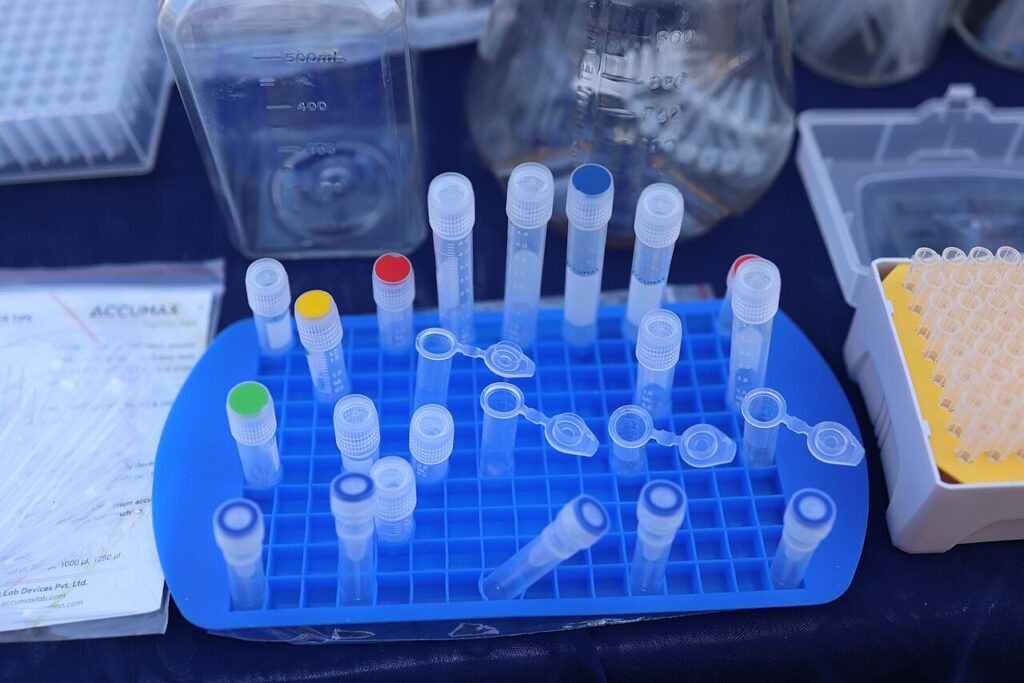
Illustrative banner: Laboratory microcentrifuge tubes and pipette tips 01.jpg by Gannu03, CC BY-SA 4.0, via Wikimedia Commons. Displayed at reduced resolution; the site may crop the display to fit the banner. The equipment and materials pictured are illustrative, not PeptaCo facilities, products, or batch results.