The Physics of Lyophilized Peptide Transfer
In the realm of biotechnology and analytical chemistry, the transition of lyophilized peptides from cold-chain storage to the analytical workbench represents a critical vulnerability in quality assurance. While thermal cycling and moisture ingress are frequently discussed, the physical dynamics of electrostatic charging and particulate generation during the initial unsealing and transfer phases are equally vital. Lyophilized peptides, by definition, possess extremely low residual moisture content. This desiccated state transforms the peptide powder into a highly effective electrical insulator.
When these vials are removed from sub-zero environments and introduced to ambient laboratory conditions, the temperature differential can induce subtle condensation on the exterior of the primary packaging. However, the interior powder matrix remains highly susceptible to triboelectric charging. Friction generated during transport, vortexing, or the physical act of opening the vial can impart a significant electrostatic charge to the peptide particles. In the context of lyophilized peptide handling, managing this static charge is paramount to ensuring gravimetric accuracy and preventing the aerosolization of valuable raw materials.
Electrostatic Mitigation Strategies for Analytical Weighing
Accurate analytical weighing is the foundational step for any downstream formulation or Mass Spectrometry workflow. When handling highly charged lyophilized powders, standard anti-static measures must be rigorously applied. The use of ionizing blowers or polonium alpha-emitting static eliminators positioned near the analytical balance is a standard operating procedure in advanced QA laboratories. These devices neutralize the electrostatic field surrounding the weighing vessel, preventing the peptide powder from clinging to the walls of the boat or being repelled by the balance pan.
Furthermore, the selection of the weighing vessel itself plays a critical role. Standard polystyrene weighing boats can exacerbate triboelectric effects. Transitioning to conductive polymers or specialized anti-static treated polypropylene vessels significantly reduces charge accumulation. Environmental controls within the weighing suite must also be optimized; maintaining relative humidity between 40% and 60% provides a microscopic conductive layer on surfaces, facilitating the natural dissipation of static charges without compromising the desiccated state of the peptide itself.
| Parameter | Target Range | QA Impact |
|---|---|---|
| Ambient Relative Humidity | 40% – 60% | Facilitates static dissipation without risking peptide hydration |
| Ionizer Balance Decay Time | < 2.0 seconds | Ensures rapid neutralization of triboelectric charges on vessels |
| Weighing Vessel Material | Conductive Polymer | Minimizes secondary charge generation during powder transfer |
| Equilibration Time | 15 – 30 minutes | Allows thermal and electrostatic stabilization prior to unsealing |
Particulate Control and Laminar Flow Dynamics
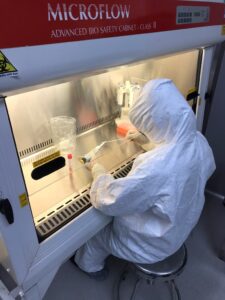
Beyond electrostatic mitigation, controlling airborne particulates during the physical transfer of lyophilized peptides is a core component of robust Quality protocols. When a vial of lyophilized peptide is opened, the sudden equalization of pressure, combined with any residual static charge, can cause fine particulates to become aerosolized. In an ISO-classified cleanroom or a certified laminar flow hood, managing these micro-aerosols is essential to prevent cross-contamination and ensure operator safety.
For organizations engaged in complex cosmetic OEM/ODM formulations, such as those integrating advanced signaling molecules like SNAP-8 or structural peptides like GHK-Cu, particulate control directly influences the final matrix clarity and stability. Transfer protocols should mandate the use of anti-static spatulas and the execution of all powder manipulation strictly within the unidirectional airflow of a certified biological safety cabinet or laminar flow workstation. This ensures that any displaced particulates are immediately captured by the HEPA filtration system, rather than settling onto adjacent analytical equipment or raw material stocks.
Integrating Transfer Protocols into Analytical Workflows
The physical handling of lyophilized peptides cannot be viewed in isolation from downstream analytical verification. If electrostatic forces cause a fraction of a milligram of peptide to adhere to the vial walls or become aerosolized during transfer, the actual mass delivered to the reconstitution solvent will deviate from the gravimetric measurement. This discrepancy creates immediate variance when reconciling the physical yield against the expected metrics outlined in the raw material COA.
Such mass transfer errors propagate through the entire analytical workflow. When preparing reference standards for HPLC purity profiling or quantitative mass spectrometry, exact concentrations are non-negotiable. A slight under-dosing of the solubilized peptide due to transfer losses will skew impurity deconvolution and alter the perceived purity profile. This is especially critical when evaluating complex, long-chain research compounds like Semaglutide or Tirzepatide, where precise molar concentrations are required to accurately map receptor binding kinetics and structural integrity in the laboratory evaluation phase. By standardizing electrostatic and particulate controls during lyophilized peptide handling, laboratories ensure that their analytical data reflects the true composition of the raw material, safeguarding the integrity of the entire supply chain.
PeptaCo supplies materials for qualified research, analytical, and formulation-development purposes. Products are not intended for direct consumer use.